Bank Indonesia Holds Benchmark Rate at 5.75%, Raises Deposit Facility Rate to 5%
22 Oct 2026
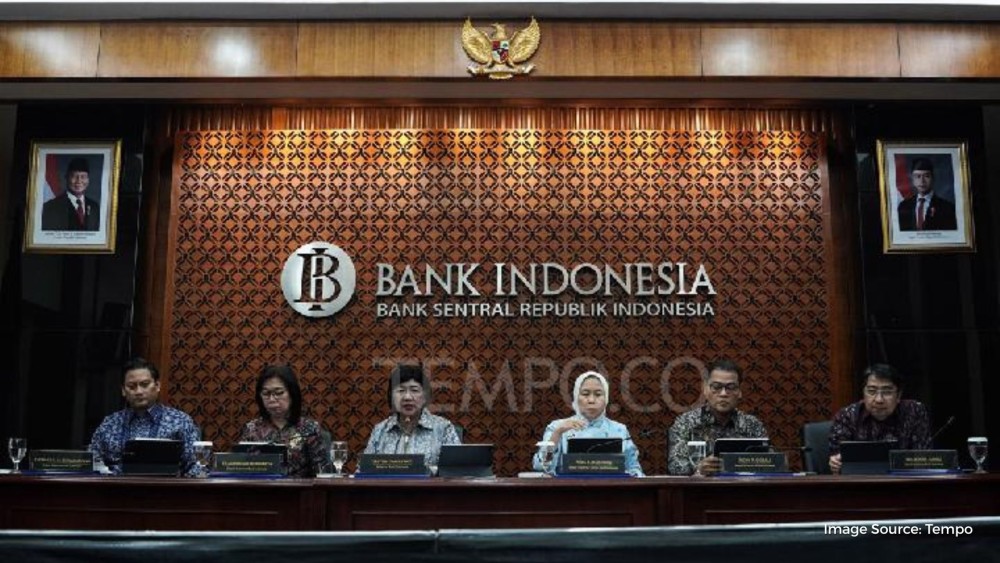
Bank Indonesia (BI) has decided to keep its benchmark interest rate, known as the BI Rate, at 5.75% following its Board of Governors Meeting on 20–21 October 2026. However, the central bank raised its deposit facility rate to 5% from its previous level.
BI Governor Destry Damayanti said the decision took into account mounting external pressures, particularly escalating geopolitical tensions in the Middle East and expectations that United States (US) monetary policy would remain tight for longer.
BI also maintained its lending facility rate at 6.5%. The decision was accompanied by stronger incentives for domestic non-deliverable forward (DNDF) hedging instruments through Bank Indonesia to attract foreign capital inflows, maintain rupiah exchange rate stability, and accelerate the development of the money and foreign exchange markets.
“The decision is reinforced by increased policy incentives for domestic non-deliverable forward (DNDF) hedging instruments through Bank Indonesia to attract foreign capital inflows, maintain rupiah exchange rate stability, and accelerate the deepening of the money and foreign exchange markets,” Destry said at a press conference following the Board of Governors Meeting at BI headquarters in Jakarta on Wednesday, 21 October.
Destry explained that the global economy continued to face high financial uncertainty, driven by rising geopolitical tensions that had kept global oil and commodity prices elevated. Global economic growth in 2026 is projected to stand at around 3%, while inflationary pressures are forecast to reach 4.6%.
Meanwhile, global monetary policy is expected to remain tight under a “higher for longer” approach. BI also highlighted the possibility of further interest rate increases by the US Federal Reserve, which could keep yields on US Treasury securities elevated.
According to Destry, these conditions have limited investor appetite for portfolio assets in emerging markets while supporting further strengthening of the US dollar.
In response to these pressures, BI continues to strengthen measures to stabilise the rupiah. The currency stood at IDR 17,985 per USD on 20 October 2026, weakening by 0.61% on a point-to-point basis compared with its position at the end of September.
Destry attributed the rupiah’s depreciation to escalating geopolitical tensions, tighter US monetary policy, and foreign investor sentiment in the stock market.
To maintain exchange rate stability, BI has been optimising various monetary instruments and strengthening incentives to encourage foreign portfolio investment inflows. According to BI data, the hedging cost incentive policy, introduced in June 2026, had attracted USD 9.9 billion in foreign capital inflows as of 20 October 2026.
Looking ahead, Destry said BI expects the rupiah to move within a stable range, supported by the central bank’s commitment to maintaining stability, attractive yields on rupiah-denominated assets, controlled inflation, and a positive domestic economic outlook.
Beyond maintaining stability, BI continues to direct its macroprudential policy towards encouraging credit growth and financing for the real sector. Banking credit grew by 13.26% year-on-year in September 2026, supported by investment credit growth of 23.2%, working capital credit growth of 11.89%, and consumer credit growth of 4.86%.
However, third-party funds (DPK) grew at a slower rate of 8.22% year-on-year. BI expects overall credit growth for 2026 to range between 8% and 12%.
Destry said BI would continue to optimise its Macroprudential Liquidity Incentive Policy (KLM) to support lending, while maintaining prudential principles and financial system stability.
Meanwhile, Indonesia’s economic growth in 2026 is projected to range between 4.9% and 5.7%.
On the price front, consumer price index inflation stood at 3.28% year-on-year in September 2026. Volatile food inflation reached 5.03%, mainly due to declining production in several key producing regions as a result of weather disruptions.
Destry reaffirmed that BI would continue to strengthen its policy mix covering monetary policy, macroprudential measures, and the payment system to maintain economic stability while supporting sustainable economic growth.
This article is published in partnership with Katadata
Original article here

RELATED ARTICLES