Indonesia Introduces New Minimum Wage Formula, To Increase by 5%–7% in 2026
17 Dec 2025
Indonesia’s minimum wage is set to increase by around 5% to 7% in 2026 following the signing of a new government regulation by President Prabowo Subianto, which revises the formula used to calculate annual wage adjustments and raises the adjustment factor applied to economic growth.
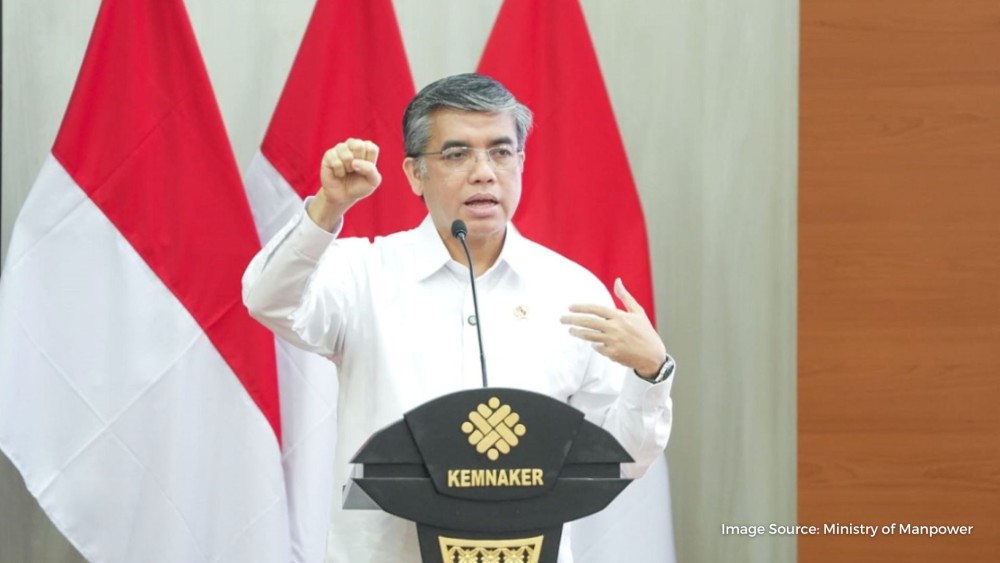
Manpower Minister Yassierli said the regulation was signed on Tuesday after months of studies and consultations, including discussions with labour unions. The new rule revises Government Regulation No. 51 of 2023 and introduces a broader range for the adjustment factor, known as alpha, which determines how much economic growth is passed on to wage increases.
Under the new framework, minimum wage adjustments will be calculated based on inflation plus economic growth multiplied by the alpha coefficient. The regulation sets the alpha range at 0.5 to 0.9, compared with 0.1 to 0.3 under the previous rule. A higher alpha results in a larger minimum wage increase.
“The calculation of the minimum wage increase will be carried out by the Regional Wage Council and submitted as a recommendation to the governor,” Yassierli said at a press conference on Wednesday. Provincial or district wage councils will determine the alpha value within the prescribed range, taking into account factors such as labour absorption and average wage levels in each region.
Regional wage councils will submit their recommendations to provincial governors, who hold the authority to set final provincial minimum wages (UMP). Governors may also establish district and city minimum wages, as well as sectoral minimum wages at the provincial level, and may do so at the district and city level.
Yassierli urged provincial governors to determine minimum wage increases no later than December 24th, 2025, in line with the new regulation, as wage decisions must be finalized before the end of the year.
Chief Economic Affairs Minister Airlangga Hartarto said economic growth would be a key variable in determining the 2026 minimum wage, with calculations based on third-quarter 2025 data. “The minimum wage depends on economic growth in the third quarter of 2025,” Airlangga said in late November.
While the final outcome will vary across regions, Jakarta’s minimum wage is projected to rise by approximately 5% to 7%. With Jakarta’s current minimum wage at IDR 5.4 million per month (USD 323.36), inflation at 2.65%, and economic growth at 5.04%, the new formula implies an increase of around 5.2% to 7.2%, depending on the alpha applied. This would raise Jakarta’s 2026 minimum wage to an estimated IDR 5.68 million to IDR 5.79 million per month.
Yassierli said the regulation reflects President Prabowo’s commitment to implementing Constitutional Court ruling No. 168/2023, which ordered lawmakers and the government to draft a new manpower law, separate from the 2023 Job Creation Law, within two years and with active participation from labour unions.
Separately, Indonesian Chamber of Commerce and Industry chairman Anindya Novyan Bakrie called for balance between worker welfare and business sustainability in setting the 2026 provincial minimum wage. He said wage decisions should strengthen communication among the government, employers, and workers to maintain stable industrial relations.
Last year, minimum wages rose by 6.5%, accompanied by assistance and incentives for workers, including discounts on workplace accident and job loss insurance contributions. Job loss benefits were also increased to 60% of salary for six months to support workers during employment transitions.
RELATED ARTICLES