Indonesia and UK Launch Strategic Partnership, Expand Maritime, Defense, and Economic Cooperation
21 Jan 2026
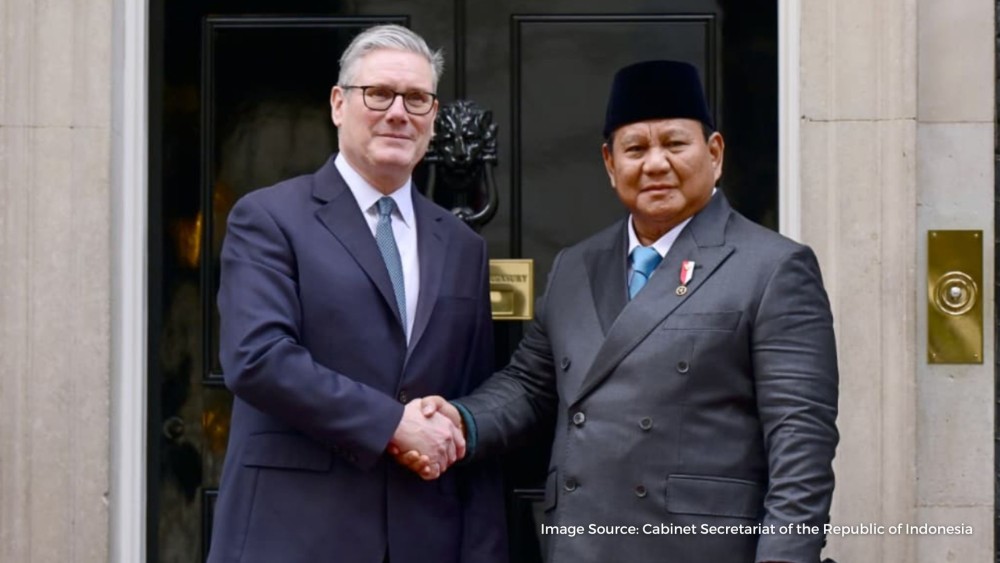
President Prabowo Subianto and British Prime Minister Keir Starmer have launched a strategic partnership aimed at deepening bilateral cooperation across defense, maritime development, economic growth, climate, and social sectors, during Prabowo’s second state visit to the United Kingdom.
Prabowo visited Starmer at 10 Downing Street, London, on Tuesday, July 12, where the two leaders held a bilateral meeting to discuss strengthening long-term cooperation between Indonesia and the UK. The partnership builds on commitments made during Prabowo’s earlier visit to Starmer’s office in November 2024.
British Ambassador to Indonesia Dominic Jermey said the strategic partnership document was a key outcome of the leaders’ talks. The framework covers four main areas of cooperation: defense and security; economic growth; people and society; and climate, energy, and nature. Education and healthcare cooperation are also included.
During the meeting, Starmer expressed appreciation for the progress in bilateral relations and thanked Prabowo for the maritime cooperation agreement reached last November.
“Thank you for the maritime agreement we signed, even though it was done virtually at the G20 Summit. The agreement is very important for Britain because it has opened up many jobs,” Starmer said.
The maritime cooperation refers to the Maritime Partnership Programme (MPP), a strategic initiative led by British defense company Babcock. Valued at up to 4 billion pounds sterling, equivalent to approximately USD 5.4 billion, the program includes efforts to strengthen Indonesia’s naval capabilities and the construction of more than 1,000 fishing vessels. Production will take place in Indonesia using British shipbuilding expertise, while the UK estimates the program will create around 1,000 jobs domestically.
Prabowo welcomed the partnership and described it as an important component of Indonesia’s maritime economic development.
“We are very satisfied with the implementation of this maritime partnership. This will be an important part of the development of our maritime economy,” Prabowo said.
Defense cooperation is also a key component of the partnership. State-owned shipbuilder PAL Indonesia has partnered with British defense company Babcock on the Merah Putih Frigate project, which is based on Babcock’s Arrowhead 140 design. The project supports Indonesia’s efforts to upgrade its military capabilities.
On trade, Jermey described Indonesia as an essential partner for the UK’s long-term economic growth. The UK is currently the world’s sixth-largest economy, while Indonesia ranks 16th globally. Indonesia is also the UK’s 54th-largest export market.
Indonesia-UK trade totaled USD 2.4 billion between January and November 2025. Over the same period, Indonesia recorded a trade surplus of USD 459.5 million, though the surplus declined by around 42% year on year. Footwear was Indonesia’s leading export to the UK, valued at approximately USD 236.8 million.
Indonesia does not yet have a bilateral free trade agreement with the UK. However, Indonesia is seeking to join the Comprehensive and Progressive Agreement for Trans-Pacific Partnership (CPTPP), which the UK joined in late December. The agreement offers significant tariff reductions among member economies.
The leaders also discussed food security and maritime livelihoods. Prabowo said the construction of fishing vessels under the MPP could help improve fishermen’s welfare, revitalize fishing villages, and increase national protein consumption. Indonesia’s aquaculture production reached 5.02 million tons as of the third quarter of 2025. In 2024, national daily protein consumption stood at 62.3 grams per capita, lower than Malaysia’s 89.1 grams per capita.
The strategic partnership formalizes closer coordination between Indonesia and the UK across maritime, defense, and economic sectors as both governments seek to strengthen long-term bilateral cooperation.
RELATED ARTICLES