This Week’s Headlines (Dec 13. – 19, 2025)
19 Dec 2025
World Bank Upgrades Indonesia’s Growth Outlook Amid Global Uncertainty
The World Bank has raised its forecast for Indonesia’s economic growth, projecting the economy to expand by 5% in 2025–2026 before climbing to 5.2% in 2027.
The upgraded outlook, published in the December 2025 edition of the Indonesia Economic Prospects (IEP) report, marks an improvement from the June forecast of 4.7% in 2025, 4.8% in 2026, and 5% in 2027.
“Despite global uncertainty, Indonesia’s economy has proven resilient. GDP growth remains around 5% annually, higher than the average for middle-income countries. This is good news,” said Carolyn Turk, the World Bank Country Director for Indonesia and Timor-Leste, in Jakarta on Tuesday, December 16, 2025, as quoted by Antara.
The report attributes the stronger outlook to rising investment and export performance, which are expected to offset slightly weaker private consumption.
Public investment through the state-backed Danantara program, accommodative monetary policy to spur private-sector credit, and steady inflows of foreign direct investment are highlighted as key drivers. Low inflation and fiscal stimulus are also expected to support household spending.
However, labor market challenges continue to weigh on household welfare. Employment rose 1.3% between August 2024 and August 2025, but most new jobs were concentrated in lower-wage sectors. Real wages have declined since 2018, while mid-skilled employment has shrunk relative to both low- and high-wage positions, dampening household consumption.
Turk stressed that Indonesia must combine macroeconomic stability with deeper structural reforms to strengthen its growth capacity and create better-paying jobs for young workers. One priority identified in the report is the expansion of digital infrastructure, including broadband networks, data centers, and regulatory frameworks, to accelerate productivity and broaden economic opportunities.
“We believe Indonesia can drive faster productivity growth and expand opportunities by improving the quality and reach of its digital infrastructure,” Turk said.
“A stronger digital ecosystem will generate new jobs in the tech sector and create multiplier effects across the economy, particularly benefiting young people and women in underserved regions,” Turk added.
Source: RRI
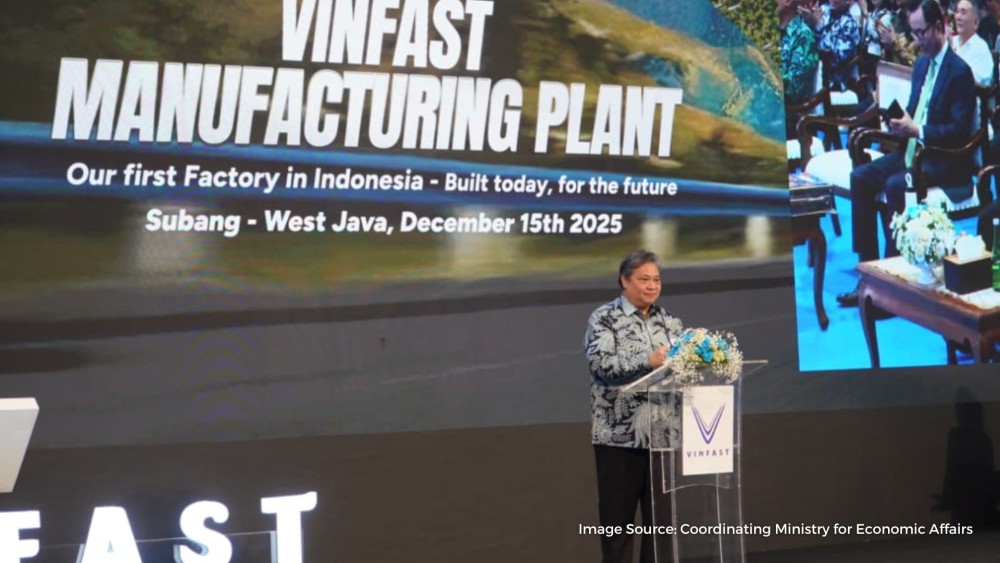
VinFast Taps Indonesia as Southeast Asia Production Hub with New Subang Plant
Vietnamese electric vehicle manufacturer VinFast has confirmed Indonesia as one of its main production bases in Southeast Asia, marked by the inauguration of its manufacturing plant in Subang, West Java, on Monday.
VinFast Asia chief executive Pham Sanh Chau said the Subang facility is the company’s second factory outside Vietnam, following an earlier expansion into India, underscoring VinFast’s ambition to scale rapidly as a global automaker.
“This is strong proof of VinFast’s capability and speed as a global company,” Chau said.
The Subang plant has an initial production capacity of around 50,000 vehicles per year and has been designed to allow future expansion to as much as 350,000 units annually, in line with rising demand and broader market reach.
To support that expansion, VinFast has committed up to USD 1 billion in investment, Coordinating Minister for Economic Affairs Airlangga Hartarto said during the inauguration ceremony.
“Their investment commitment in Indonesia reaches USD 1 billion, or about IDR 16 trillion. This will be used to expand production capacity from 50,000 units to 350,000 units per year,” Airlangga said.
The Indonesian government has welcomed the move, citing its potential multiplier effects on the economy, including job creation and the strengthening of domestic supporting industries.
VinFast Trading Indonesia chief executive Kariyanto Hardjosoemantoro said the new factory is expected to initially employ around 900 workers directly.
“In the next stages, the workforce could grow to between 5,000 and 15,000 employees, depending on the factory’s operational needs,” Kariyanto said.
Construction of the Subang plant began around 17 months ago on nearly 10 hectares of land, with an initial investment of about USD 300 million, he added.
The facility’s presence in Indonesia is also expected to shorten distribution times for VinFast vehicles, serving both the domestic market and the wider Southeast Asian region, given the country’s strategic location.
Battery Leasing to Lower Prices
To make its electric vehicles more affordable, VinFast is offering a battery leasing scheme in Indonesia as an alternative to engaging in aggressive price competition, Kariyanto said.
Under the scheme, customers can purchase vehicles without batteries at a lower upfront price and lease the battery separately. As an example, the VinFast VF 3 is priced at around IDR 209 million with a battery included, while the battery leasing option reduces the purchase price to about IDR 145 million.
Beyond the lower entry price, battery leasing also provides customers with assurance that battery performance and maintenance remain the responsibility of VinFast, helping ensure long-term reliability and optimal condition.
Source: Jakarta Globe
Indonesia Ships First Frozen Durian Export to China
The Indonesian Agricultural Quarantine Agency (Barantin) has officially released the country’s first export of frozen durian, totaling 48 tons, to China from Citereup, Bogor, West Java, on Monday.
Barantin Head Sahat M Panggabean stated that the inaugural shipment, valued at IDR 5.1 billion or USD 305,971, was a follow-up to the signing of the frozen durian export protocol between Indonesia and the General Administration of Customs of the People’s Republic of China (GACC) on May 25, 2025.
“This marks the realization of Indonesia’s first frozen durian export to China, the result of a long process that required considerable time and resources,” Panggabean stated in Barantin’s official statement.
The frozen durians, processed in West Java, will be shipped via Tanjung Priok Port in Jakarta to Qingdao Port, China.
Previously, Indonesian durian exports to China were not conducted directly, but instead sent through neighboring countries that processed and repackaged the fruit before sending it to the Chinese market.
The government-to-government initiative with GACC has now paved the way for Indonesia to export frozen durian directly.
Barantin recorded that from January to November 2025, Indonesia exported 10,162 tons of durian in various forms, including durian pulp, durian paste, and whole durian.
The five main export destinations were Thailand (6,003 tons), China (2,574 tons), Malaysia (1,532 tons), Hong Kong (15 tons), and Germany (6 tons). Other destinations included Japan, Taiwan, Saudi Arabia, the Czech Republic, the Netherlands, Canada, the United States, and Norway.
On the same occasion, Secretary General of the Indonesian Durian Plantation Association (Apdurin), Aditya Pradewo, welcomed the opportunity for direct exports to China. He noted that the Chinese durian market is estimated at USD 8 billion, or around IDR 128 trillion, annually.
He explained that with premium varieties such as Bawor, Super Tembaga, and Namlung, Indonesia is projected to secure 5–10% of the market share, which if achieved could generate foreign exchange earnings ranging from IDR 6.4 trillion to IDR 12.8 trillion per year.
Pradewo added that direct exports to China not only reduce logistics costs but also provide significant benefits for farmers and exporters.
According to him, durian prices in China are currently five to seven times higher than local prices, offering substantial economic opportunities.
Source: Antara News
RELATED ARTICLES


COMPANIES IN THIS SECTOR