This Week's Headlines (Feb. 14 - 20, 2026)
20 Feb 2026
Indonesia Secures 19% Tariff Deal with US, Palm Oil and Other Commodities Exempt
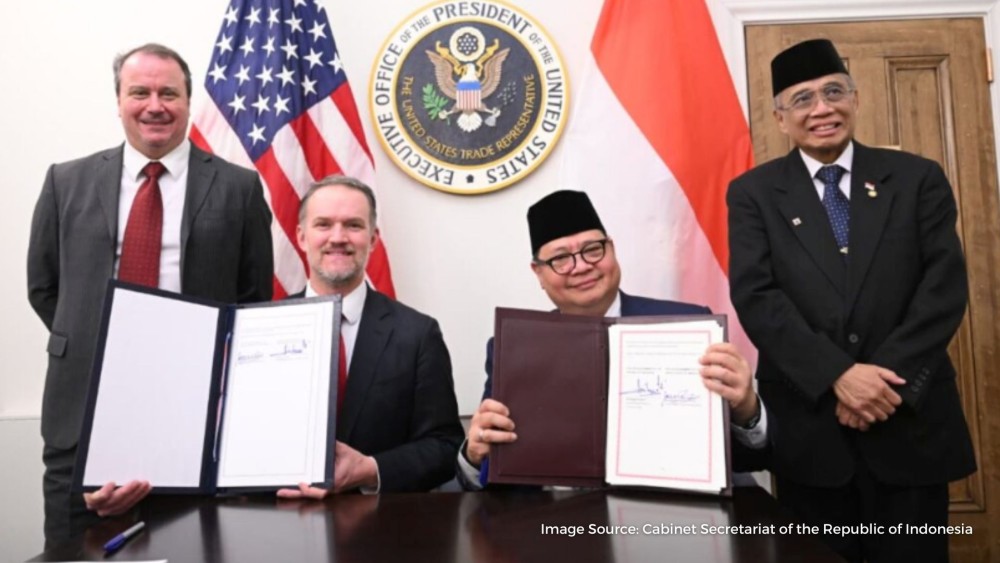
Indonesia and the United States finalised a trade deal to cut U.S. levies to 19% from 32% on goods shipped from Southeast Asia's biggest economy, with Jakarta securing tariff exemptions for its top export, palm oil, and several other commodities.
The agreement was signed in Washington by Indonesia's senior economic minister Airlangga Hartarto and U.S. Trade Representative Jamieson Greer after months of negotiations.
"This deal respects the sovereignty of both countries," Airlangga said during an online press conference, describing the deal as a "win-win" for both countries.
Palm oil was a particularly important exemption, accounting for around 9% of Indonesia's overall exports.
Indonesian coffee, cocoa, rubber and spices would also be tariff-free, Airlangga said.
Deal Comes After Trying Start to 2026
The 19% rate is on par with U.S. deals with Southeast Asian rivals such as Malaysia, Cambodia, Thailand and the Philippines. Vietnam, however, has a slightly higher rate of 20%.
Malaysia, another major exporter of palm oil, also has a tariff exemption for that product, as well as for cocoa and rubber.
The deal comes after a rough start to the year for Indonesian markets. Setbacks include last month's warning from index provider MSCI that the equity market risked a downgrade to "frontier" status over transparency issues, as well as Moody’s cutting of the country's credit rating outlook two weeks ago that cited reduced predictability in policy making.
Investor confidence in Indonesia could improve if Jakarta uses the U.S. deal as a springboard for further reform, said Yose Rizal Damuri, executive director of CSIS Indonesia.
"If Indonesia could multilateralize some of its commitments to the United States and use them as a basis for deregulation, that would increase trust in Indonesia and that's something that should be taken advantage of, optimized," he added.
Indonesia to Accept US Product Standards
Under the deal, textile products from Indonesia will be subject to a 0% levy under a quota mechanism that is still to be discussed. The quota will be determined by the quantity of U.S. materials such as cotton and man-made fibre used in textiles.
The U.S. dropped requests to add non-economic provisions to the deal, including those related to nuclear reactor development and the South China Sea, Airlangga said.
In return, Indonesia will remove tariff barriers on most U.S. products across all sectors and address a range of non-tariff barriers such as local content requirements, according to a White House fact sheet.
It will also accept U.S. product standards on vehicle safety, emissions, medical devices and pharmaceuticals.
Deal to Help US Interests in Critical Minerals
The deal also appears to take aim at what analysts have said are concerns in Washington about China's stranglehold on many critical minerals and the offshoring of Chinese companies' operations to countries like Indonesia.
Under the agreement, Indonesia will implement restrictions on 'excess production' by foreign-owned mineral processing facilities by ensuring production conforms to Indonesian mining quotas. Such minerals include nickel, cobalt, bauxite, copper and manganese.
Jakarta has also agreed to take action against companies owned or controlled by foreign countries operating within its jurisdiction when their practices harm U.S. trade interests.
And Indonesia will facilitate U.S. investment in critical minerals and energy resources as well as cooperate with U.S. companies on expediting development of its rare-earth sector.
The deal is due to take effect 90 days after both sides complete related legal procedures, Airlangga said, adding that changes could still occur if both sides agree.
President Prabowo Subianto has travelled to Washington for the deal and to attend the first leaders' meeting of U.S. President Donald Trump's Board of Peace.
Prabowo and Trump on Friday signed a document titled "Implementation of the Agreement Toward a NEW GOLDEN AGE for the U.S.-Indonesian Alliance" which the White House said would help both countries to strengthen economic security and growth.
Earlier this week, Indonesian and U.S. companies signed deals worth USD 38.4 billion.
Source: Reuters
BI Holds Rate Steady Amid Rupiah Volatility Bouts
The central bank governor Perry Warjiyo said that global uncertainty increased risk premiums and created “short-term pressures toward the exchange rate”.
Bank Indonesia (BI) has decided for the fifth month in a row to maintain its benchmark interest rate despite low inflation in order to stabilize the rupiah exchange rate that has been going through volatility bouts for the past month.
Following the central bank’s two-day monthly policy meeting, BI Governor Perry Warjiyo announced in a press conference on Thursday that the BI Rate would remain where it has been since last September at 4.75%.
“We are still consistent, our view is still that the room for interest rate reduction remains open given the low inflation and economic growth that needs to be pushed,” said Perry.
“However, under current global conditions that still possess high uncertainty, we, of course, will be data-dependent. We will keep a close eye on future opportunities to realize interest rate cuts,” he added.
Inflation has been kept in check within the central bank’s target range of 2.5 plus minus 1 percent for more than two years until it struck the ceiling in January when the consumer price index growth touched 3.55% year-on-year (yoy).
BI projected the inflation to stay elevated up until March but attributed the rise to base effect resulting from last year’s 50 percent electricity discount in January and February of 2025, which brought down CPI growth to under 1% yoy during the discount period.
The monetary authority forecast inflation to be below 3% for this year, comfortably within the target as has been the case since mid-2023.
Despite the low inflation, BI could not proceed with cutting the rate as it wills because on the other end of the balance is rupiah exchange rate that has to be maintained, as per the central bank’s mandate in the law.
Perry said the rupiah has recently been “undervalued” but viewed that “it will become more stable and inclined to strengthen going forward”, thanks to Indonesia’s economic fundamentals comprising inflation, economic growth and bond yields, among other indicators.
The archipelago’s economic indicators have been consistently showing promising readings for a sustained period but the rupiah exchange rate was nevertheless battered when global circumstances showed signs of turbulence, thanks to the rupiah status as a riskier asset.
Perry said the global uncertainty increased risk premiums and created “short-term pressures toward the exchange rate”, which BI responded with increasing the intensity of intervention via multiple foreign exchange markets.
Not all pressures, however, originated from the global situation given that the currency flirted with its historic low late last month when President Prabowo Subianto nominated his nephew Thomas Djiwandono as a BI deputy governor, who went on to become one and attended the Thursday press conference.
The rupiah became the outlier that week since other currencies were strengthening against the United States dollar. It proceeded to regain some footing afterward but has seemingly re-entered the volatility bout this week, courtesy of the decision and signals from the US Federal Reserve.
Much like BI, the Fed decided to hold the rate in place in the last month’s meeting but the monetary policymakers did not seem to be in a rush to cut the federal funds rate (FFR) due to sticky inflation, as the meeting’s minutes showed.
Rupiah will lose its appeal when BI Rate gets too close to the FFR since rupiah is perceived as a far riskier asset compared to the greenback. Perry said the possibility of an FFR cut this year is still there by virtue of the “weak labor market” in the US.
Permata Bank chief economist Josua Pardede wrote in an analysis on Thursday that the room for BI-Rate cut this year is “limited” and predicted the central bank to only do so in the second half.
“In the near term, BI is likely to hold the rate to safeguard stability amid heightened geopolitical risks and domestic market uncertainty following the MSCI warning and outlook downgrade by Moody’s, which have lifted risk premiums, triggered outflows and pressured the rupiah,” said Josua.
The Indonesian financial market has been undergoing its own turbulence since the global index compiler MSCI, formerly Morgan Stanley Capital International, threatened to relegate Indonesia from emerging market to frontier market status due to transparency concerns last month.
Josua noted that the inflationary impact of the US tariffs has yet to fully materialize, spelling less “likelihood of aggressive Fed easing” this year and thus projected that BI would only cut its rate once by 25 basis points this year.
Bank Danamon economist Hosianna Evalita Situmorang wrote in an analysis on Thursday that “BI is expected to prioritize exchange rate stability”, which suggested cautiousness.
Source: The Jakarta Post
Jakarta Lunar New Year Boosts USD 533 Million Spending
Jakarta generated IDR 9 trillion (USD 532.7 million) in economic activity during the 2026 Lunar New Year holiday, underscoring the growing role of large-scale cultural events in driving consumption in Southeast Asia’s biggest economy, Deputy Governor Rano Karno said Wednesday.
“The Lunar New Year celebrations generated IDR 9 trillion in economic circulation in Jakarta,” Karno told reporters in the capital, citing preliminary government estimates.
The provincial administration now expects spending during Ramadan and the run-up to Eid al-Fitr to surpass IDR 20 trillion (USD 1.2 billion). This year, the Hindu Day of Silence, Nyepi, falls on March 8, creating a dense holiday calendar that officials believe will further stimulate retail and tourism activity.
Jakarta staged a five-day Lunar New Year Festival at the Hotel Indonesia traffic circle from Feb. 13 to 17, 2026, transforming the city’s main commercial artery into a showcase of cultural attractions.
Highlights included 3D lantern installations depicting the 12 Chinese zodiac signs, a lantern parade, an LED “Pagoda of Harmony Light,” appearances by the God of Fortune Cai Sen Ye, dragon and lion dances, and laser performances designed to draw visitors and boost foot traffic for surrounding businesses.
To expand the festive impact, the administration also organized a citywide decoration competition involving 98 buildings. The contest, which ran through Feb. 17, aimed to spread celebrations beyond traditional Chinatown areas into office towers, malls and mixed-use developments.
Additional events included the Jakarta Chinatown Festival at Taman Mini Indonesia Indah from Feb. 15 to 17, Harmoni Jakarta at Blok M Hub, and a national Lunar New Year celebration featuring video mapping at the National Monument complex.
A special edition of the Jakarta Light Festival was staged in the Kota Tua heritage district on Feb. 16 and 17.
The administration also hosted the Jakarta Temple Festival, coordinating celebrations across temples citywide, with festivities set to culminate in Cap Go Meh on March 3 in Glodok Chinatown.
On Tuesday evening, officials marked a symbolic transition to Ramadan 1447 Hijri at the Hotel Indonesia circle, blending Islamic-themed cultural performances with Lunar New Year motifs to emphasize Jakarta’s religious diversity.
Source: Antara News

RELATED ARTICLES