This Week's Headlines (June 20-26, 2026)
26 Jun 2026
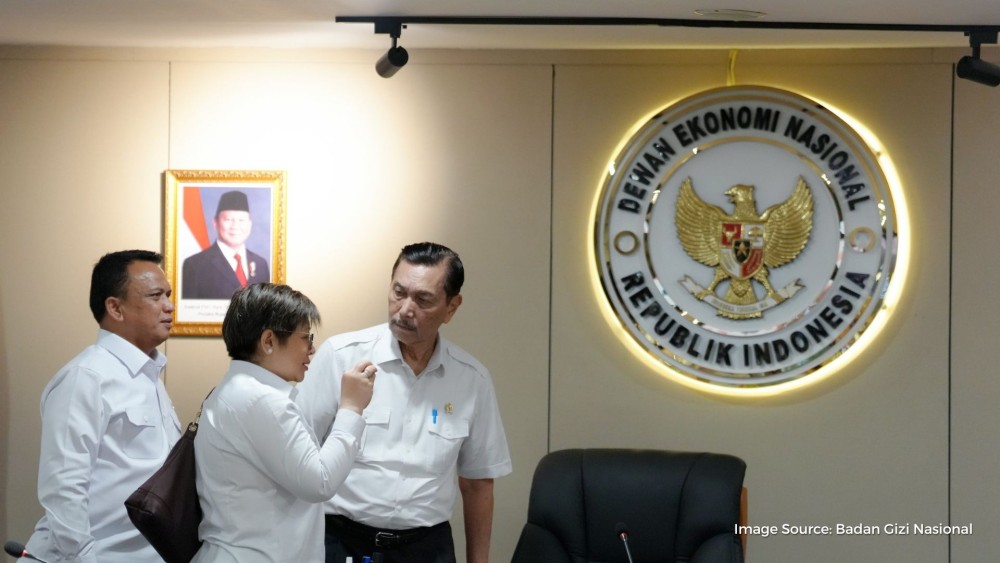
Indonesia Weighs USD 2 Billion Cut to Prabowo's Signature Free Meals Program
Indonesia is preparing to scale back President Prabowo Subianto 's flagship free meals program, with officials weighing another budget cut of more than USD 2 billion along with reductions in kitchens and beneficiaries, according to two sources familiar with the matter and an internal presentation.
The planned move marks one of the clearest indications yet of mounting fiscal and governance pressures on Prabowo's most important and expensive campaign pledge, which has been central to concerns about Indonesia’s fiscal discipline.
Two sources familiar with the plans told Reuters the National Nutrition Agency (BGN), which runs the program, is targeting a reduction of at least 15 percent from its 268 trillion rupiah (USD 16 billion) budget this year – equivalent to about IDR 40 trillion – after identifying inefficiencies.
One of them said the cut could be IDR 50 trillion.
The two sources said the exact reduction was not known. But a third source said an internal review could cut recipients to 49 million from 62.5 million, though the assessment is ongoing and subject to change.
The sources spoke on condition of anonymity as the matter was still private.
The Ministry of Finance is "awaiting a budget sharpening plan" from the NNA and will coordinate on any roll-out, a spokesperson told Reuters in a written reply on Thursday.
The BGN and the President's office did not immediately respond to Reuters' requests for comment.
The details of the rollback plan, including the cut in recipients and internal discussions, have not been reported before.
Recipients will be cut by tightening the social and economic criteria, according to a presentation meant for parliament seen by Reuters.
The agency will temporarily halt the addition of over 13,000 new kitchens to the rapidly expanding program, which started only in January 2025 and became one of the biggest such programs in the world, the presentation showed.
The rollback plan has been discussed with a parliamentary commission and a final decision is expected to be agreed in the next few weeks, the sources said.
'Total redesign'
"This program requires a total redesign, involving less-centralised system," one of the sources said, adding that the government should consider building school-based kitchens just like other countries such as Japan or China to reduce spending, rather than building new ones.
Investor and global ratings agency concerns over governance issues, financial mismanagement and the strain on Indonesia's budget have already weighed on sentiment around the program.
Prabowo and his ministers have previously brushed aside the concerns and pledged to press on with the initiative, which was launched in 2025 with great fanfare and rapid expansion. It initially had 335 trillion rupiah allocated to it in 2026, and set a target of 83 million recipients – a figure Prabowo stressed in a number of speeches.
The allocation was reduced to IDR 268 trillion in May as the government sought more fiscal room in the aftermath of the Iran war.
The new planned cut would reduce it further. The presentation indicated the 83 million recipient target would not be enforced this year.
The rollback comes days after the former head of the nutrition agency was fired by Prabowo and later arrested on charges of mismanagement and alleged corruption.
"It’s not just because our fiscal is limited but due to the case [arrest], the agency has identified a great deal of unnecessary spending," the second source said.
"Budget cuts are necessary so the government could see objectively which spendings are actually essential," the second source added.
'Efficiencies, not cuts'
The third source said the changes should be seen as "savings" and "efficiencies" rather than outright budget cuts.
Of the more than 27,000 kitchens currently operating under government contracts, only around 21,000 are actually needed, the source said.
The agency previously announced some efficiency measures, which include a moratorium on new kitchens, refocusing of free meals' recipients, and halting distribution during school breaks.
But analysts said the government is trying to soften public perception and political impact on Prabowo by avoiding language that signals retrenchment.
In order to manage public perception, the government has avoided words with negative connotations such as "budget cut" and instead used words such as "budget efficiency," "refocusing" or "budget sharpening," said Yanuar Nugroho, a visiting senior fellow at Yusof Ishak Institute, a Singapore-based think tank.
"From a fiscal perspective, scaling back is indeed a rational move [...] politically, however, the impact could be multi-layered for Prabowo," Yanuar said, adding it could impact grassroots voters.
Arya Fernandes, a political analyst at the Centre for Strategic and International Studies, agreed and said the use of the word "cuts" could trigger concerns about fiscal pressure and the program's continuity.
The President's office did not immediately reply to a request for comment on the possible political fallout.
Source: The Jakarta Post
Indonesia Drafts New Law for ‘Dubai-Level’ Bali Financial Center
Indonesia is drafting a regulation dedicated to the upcoming international financial center in Bali, according to a senior official, as the government stays optimistic that it will be on par with Dubai.
In recent months, Southeast Asia’s biggest economy has been fast-tracking its plan to set up a global financial center. The rationale behind this ambition is to capture global capital as investors flee the conflict-struck Middle East to safe havens. The government has also picked Bali—a global tourist destination—as the location.
Chief Economic Affairs Minister Airlangga Hartarto confirmed that a new regulation was in the works as talks began with the Constitutional Court.
“We have discussed the legal structure of the financial center. We are still drafting the law,” Airlangga spoke to reporters in Jakarta on Monday evening.
He raised the possibility of Indonesia expanding the financial centers to other locations, but “chose to focus on Bali for now”.
The government is now trying to identify the best incentives to offer its investors. The minister added: “We will give special incentives, just like what we do with the other special economic zones [SEZs]. We are still finalizing the incentives, but we will make it in a way that our financial center is on Dubai’s caliber”.
Past government statements had indicated that the special treatment would include tax exemptions.
Airlangga had previously signaled that Indonesia would adopt a “common law”—à la Singapore—for the financial SEZ.
Reports show that common law tends to provide better certainty as it puts strong emphasis on letting judges follow previously decided cases. This way, investors can easily predict their legal outcomes. The civil law applied in Indonesia, on the other hand, has the judges making their decisions strictly based on written laws.
“We are consulting with the Constitutional Court on whether we should adopt common law in our [financial] SEZ,” Airlangga said in his office earlier this month.
He stated that the government would “take advantage of the newly approved financial law” that had revised tons of existing regulations.
A copy of the document showed that Indonesia had opened up the possibilities of having more than one financial center. It will also roll out another law expanding on the technical details by September. The law also states that a “council” will oversee the center.
The United Arab Emirates has turned into a global investment hub, mainly thanks to its Dubai International Financial Center (DIFC). It has also facilitated trade and investment flows across the Middle East, Africa, and South Asia.
Bhima Yudhistira of the economic think-tank Celios had urged the government to copy DIFC’s moves on having an independent regulator for transactions in and from the zone if it wants to gain investors’ trust.
“If we take a look at the DIFC, the key lies in the independent and professional authority. Indonesia must have an authoritative body dedicated to making a financial center that has a good track record and of integrity,” Bhima told the Jakarta Globe, not long ago.
Source: Jakarta Globe
APINDO Pushes For Joint Task Force to Ensure IEU-CEPA Ratification
The Indonesian Employers Association (APINDO) is pushing for the formation of a joint task force for the Indonesia-European Union Comprehensive Economic Partnership Agreement (IEU-CEPA).
The task force is expected to serve as a government-business community collaborative mechanism to ensure the agreement is ratified on schedule.
Apindo Chairperson Shinta Kamdani, in an official statement confirmed in Jakarta on Wednesday, stated that the proposal was a key outcome of the Apindo Business Mission to Europe 2026, which took place from June 11 to 19 across Amsterdam, The Hague, Brussels, and Paris.
Apindo assesses that the post-negotiation phase of the IEU-CEPA is a critical stage to ensure that the agreement provides tangible benefits to businesses.
Following the substantial conclusion of the agreement in September 2025, the next focus is on completing the legal finalization and ratification process to ensure effective implementation.
"Now, we must shift our focus from negotiation toward opportunity and partnership," she said.
Furthermore, the association stressed the growing urgency of implementing the IEU-CEPA, given that Indonesia’s current European Union Generalized Scheme of Preferences (GSP) benefits are set to expire on December 31, 2026.
Starting January 1, 2027, Indonesia is scheduled to graduate from the Standard GSP beneficiary list after being classified as an upper-middle-income country for several consecutive years.
If the GSP benefits expire before the IEU-CEPA takes effect, several Indonesian exports could face the EU's higher Most Favored Nation (MFN) tariffs rates, increasing trade costs.
As a result, Apindo views the IEU-CEPA as a strategic instrument that will not only replace the GSP facility but also secure long-term market access certainty, strengthen supply chain integration, boost investment, and unlock broader economic cooperation between Indonesia and the EU.
"This agreement must serve as a platform to boost investment, capacity building, technology and knowledge transfer, industrial development, business certainty, and the competitiveness of Indonesian businesses," she said.
In addition to the joint task force proposal, Apindo's mission also yielded several strategic follow-up agendas, including strengthening support for agreement implementation, maximizing the utilization of the IEU-CEPA post-ratification, and deepening dialogue on the EU Deforestation Regulation (EUDR).
"Apindo is ready to work with the Indonesian government, the European Union, and all stakeholders to ensure that the ratification and implementation of the IEU-CEPA proceed on schedule and deliver tangible benefits to both economies," Shinta said.
Source: Antara News

RELATED ARTICLES