This Week's Headlines (July 25-31, 2026)
31 Jul 2026
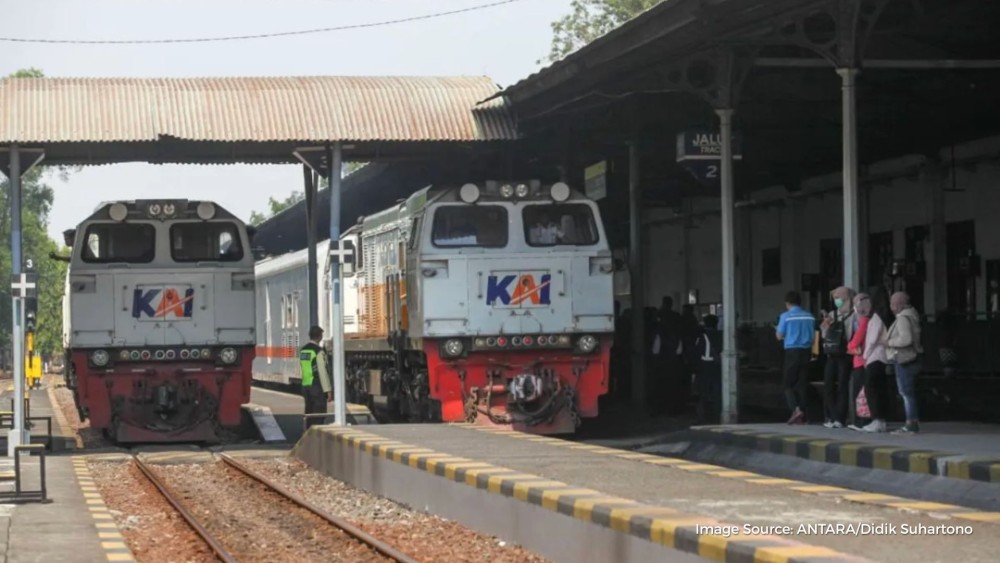
Germany backs USD 250 Million Surabaya Rail Project Set For Construction Next Year
Germany is backing the first phase of Indonesia’s Surabaya Regional Railway Line (SRRL) project with 236 million euros (US$256 million) in financing, as the country prepares to begin construction of the commuter rail line next year.
The initiative, part of the European Union's broader Global Gateway strategy, aims to develop the Greater Surabaya commuter corridor into the region’s first electrified rail line.
"We are proud to contribute to Indonesia's sustainable mobility ambitions through initiatives such as the Surabaya Regional Railway Line," designated Deputy Head of Mission at the German Embassy in Jakarta Oliver Sperling said in a statement on Wednesday.
Sperling said Germany and Indonesia had built a long-standing partnership in transport infrastructure and that German and European companies stood ready to support Indonesia's transition toward climate-resilient transport systems by bringing engineering expertise, innovative technologies and long-lasting infrastructure solutions.
The financing, provided through Germany's state-owned KfW Development Bank will fund the first phase of the Surabaya Regional Railway Line (SRRL), which aims to modernize, double-track and fully electrify the commuter corridor linking Surabaya with neighboring Sidoarjo.
The financing package comprises a concessional loan of approximately 230 million euros and a 6-million-euro technical assistance grant from KfW, alongside counterpart funding from the Indonesian government.
It is currently undergoing detailed engineering design and procurement, with construction expected to begin between 2027 and 2028.
The SRRL is among the country’s priority infrastructure projects under the 2025-2029 national development plan for the Greater Surabaya metropolitan area. Its first phase will cover a roughly 37-kilometer section connecting Surabaya Gubeng Station with Sidoarjo Station.
Once operational, the upgraded railway is expected to serve more than 200,000 passengers daily and benefit over 1.3 million residents within its first two years.
“Sustainable transport is fundamental to Indonesia's economic growth, connectivity and green transition,” said Denis Chaibi, ambassador of the EU to Indonesia and Brunei Darussalam.
Chaibi said the railway project reflects the EU’s Global Gateway strategy, under which the bloc seeks to mobilize high-quality investment, share European expertise and build long-term partnerships for resilient, low-carbon infrastructure in partner countries.
The SRRL has entered the detailed engineering design (DED) stage and is expected to move into procurement in early 2027, East Java Vice Governor Emil Elestianto Dardak said in his Instagram post on Wednesday.
The DED, being prepared by Japanese engineering consultant Chodai, involves producing detailed technical plans for the project, including station designs, the double-track railway alignment, electrification systems and supporting infrastructure.
Emil said the Surabaya-Sidoarjo section is the only corridor in northern and southern East Java that has yet to be double-tracked, despite serving the Greater Surabaya metropolitan area, home to around 10 million people.
"President Prabowo Subianto has given the clearance for it to proceed. […] The double track is needed because it will allow multiple rail services to operate simultaneously," Emil said.
He also said construction would prioritize land that has already been cleared for development, while local governments are preparing supporting spatial planning as part of the project’s implementation.
Source: The Jakarta Post
Indonesia's INA Ranks Second in Asia for Sovereign Wealth Governance
Indonesia Investment Authority (INA) ranked second among Asia's sovereign wealth funds for governance, sustainability, and institutional resilience in the 2026 Governance, Sustainability and Resilience (GSR) Scoreboard released by Global SWF.
INA earned an overall score of 92 percent, placing just behind Singapore's Temasek Holdings and underscoring growing international recognition of its governance standards and institutional credibility.
INA received 9 out of 10 points for governance, 9 out of 10 for sustainability, and a perfect 5 out of 5 for resilience in the independent assessment conducted by Global SWF.
Chair of the Board of Directors of Indonesia Investment Authority Oki Ramadhana said the recognition comes at a time when governance and institutional credibility have become increasingly important to investors amid global uncertainty and geopolitical tensions.
"Amid uncertainty, geopolitical tensions, and changes in the global economic environment, the GSR Scoreboard has become increasingly important for any institution seeking to attract investment, especially for INA, whose mandate is to bring both domestic and foreign investment into Indonesia," Oki told a press conference in Jakarta on Tuesday.
He said global investors no longer evaluate sovereign wealth funds solely by the size of their assets or investment portfolios, but also by governance quality, transparency, investment discipline, and institutional resilience.
According to Oki, the GSR Scoreboard assesses about 25 indicators covering governance, sustainability, and institutional resilience, making it an important benchmark for investors seeking credible investment partners.
"What matters most is governance. Our international investment partners view governance as the primary factor when selecting partners to invest in Indonesia," he said.
Oki said the achievement is expected to strengthen global investor confidence in Indonesia and encourage greater investment into the country's economy.
Global SWF is an independent research platform that monitors about 200 sovereign wealth funds and public pension funds worldwide by assessing governance, sustainability, and institutional resilience based on publicly available information.
Since its establishment in 2021, INA has steadily improved its GSR Scoreboard performance, increasing its score from 24 percent in 2021 to 52 percent in 2022, 56 percent in 2023, 60 percent in 2024, 68 percent in 2025, and 92 percent in 2026.
Source: ANTARA News
Indonesia Expects Auto Sales to Top 850,000 Units in 2026 as Market Recovers
Indonesia expects domestic vehicle sales to exceed 850,000 units in 2026, on the back of a recovery in production and wholesale deliveries during the first half of the year, Industry Minister Agus Gumiwang Kartasasmita said on Thursday.
National vehicle production reached 615,000 units in the January-June period, up 11.3% from a year earlier, while wholesale sales—shipments from manufacturers to dealers—rose 15.9% to 436,000 units, Agus said while opening the 2026 Gaikindo Indonesia International Auto Show (GIIAS) in Tangerang.
"Based on these figures, we are optimistic that automotive sales this year will, God willing, exceed 850,000 units," he said.
The projection would mark a recovery from the industry's recent downturn but remain below pre-pandemic highs. Indonesia's car market peaked at nearly 1.23 million units in 2013 and returned above the one-million mark in 2023, when wholesale sales reached 1.008 million vehicles.
Demand has since weakened as softer household purchasing power weighed on consumer spending. Wholesale sales fell to 865,723 units in 2024 and declined further to 803,687 units in 2025.
Despite the improvement, Agus argued that 850,000 units should not be viewed as the industry's ceiling, saying Indonesia's automotive market remains far from saturated.
Indonesia has just 19 passenger cars for every 1,000 people, compared with 275 in Thailand and 490 in Malaysia, according to government data. With a population approaching 290 million, each one-point increase in vehicle ownership could generate demand for roughly 280,000 additional cars.
"The target of 850,000 units should not be regarded as the upper limit," Agus said. "It is merely a starting point because Indonesia's automotive market is still far from saturation. In many ways, our automotive market is only just beginning."
The minister said the government wants future demand to be met increasingly by vehicles manufactured domestically rather than imports, reinforcing Indonesia's ambitions to become a regional automotive production hub.
"This growth opportunity should not be filled by imported products, but by vehicles produced in Indonesia across every level of the industrial value chain," he said.
Agus also pointed to improving trade performance as evidence of the sector's transformation. Exports of completely built-up (CBU) vehicles rose 7.7% in the first half of the year, while exports of completely knocked down (CKD) vehicles surged 38%. Component exports climbed 46%, even as vehicle imports declined.
The shift, he said, suggests Indonesia is evolving from one of Southeast Asia's largest consumer markets into a manufacturing and export base for the automotive industry.
"Indonesia is no longer simply exporting vehicles," Agus said. "We are beginning to export the capability to manufacture them."
Source: Jakarta Globe

RELATED ARTICLES