Indonesia’s Manufacturing PMI Continues to Expand
02 Dec 2025
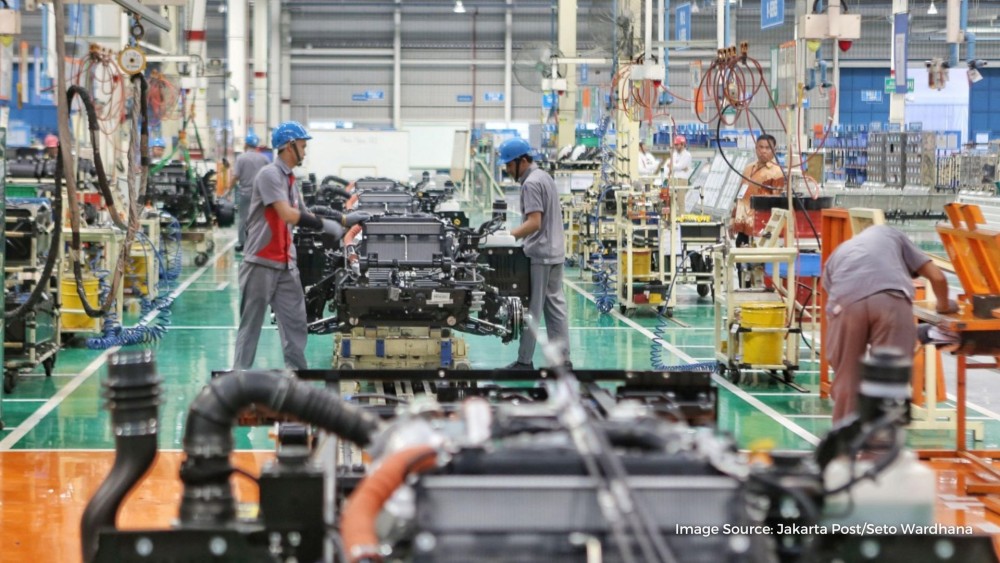
Coordinating Minister for Economic Affairs Airlangga Hartarto said national manufacturing businesses remain optimistic about Indonesia’s economic outlook. This was reflected in Indonesia’s Manufacturing Purchasing Managers’ Index (PMI) for November 2025, which rose back above the 50.0 threshold to 53.3.
According to Airlangga, the improvement in the manufacturing sector was driven by strengthening domestic market conditions. He noted at least three factors supporting this domestic optimism: government budget placements in banks, reductions in the benchmark interest rate, and rising investment in battery-electric vehicles (BEVs).
“The domestic market has begun to improve, and forward-looking risk perception is also showing signs of improvement. So, the economic policies this year will hopefully become a driver of growth in 2026,” Airlangga said at the National Leadership Meeting of the Indonesian Chamber of Commerce and Industry in Jakarta on Monday, December 1, 2025.
The PMI measures a country’s manufacturing performance. A reading below 50.0 indicates contraction, while a figure above 50.0 signals expansion.
According to Airlangga, one factor pushing the PMI above 50.0 is the reduction of BEV prices to below IDR 300 million per unit. He said some BEVs are currently priced between IDR 175 million and IDR 195 million in the domestic market.
This price condition supported BEV sales growth of 18.27% year-on-year for the January–September 2025 period. As a result, Airlangga said there is an emerging shift in new car purchases from conventional vehicles to BEVs.
“The presence of BEVs has pushed overall car prices downward. This situation has never occurred before,” he said.
S&P on Indonesia’s Manufacturing PMI
S&P Global Market Intelligence economist Usamah Bhatti said Indonesia’s Manufacturing PMI increase to 53.3 in November 2025 was driven by stronger new orders in the manufacturing sector. Domestic market demand became the main driver for non-oil and gas manufacturing performance at the end of the year.
Usamah noted that rising new orders led to higher inventory volumes of finished goods in warehouses, as manufacturers expect strong domestic demand to continue in the coming months.
The manufacturing sector also began increasing hiring in November 2025, signaling improved business confidence heading into next year.
“Optimism increased after domestic market demand strengthened for four consecutive months, followed by rising consumer purchasing power,” he said.
This article is published in partnership with Katadata
Original article here

RELATED ARTICLES



COMPANIES IN THIS SECTOR