This Week's Headlines (Feb. 7 - 13, 2026)
13 Feb 2026

Retail Sales Post Strong Annual Gain as Consumer Confidence Holds Up
Indonesian consumers are upbeat heading into the new year thanks to rising optimism about the near-term outlook, and retail sales are far stronger than a year ago, according to preliminary data.
Survey results published by Bank Indonesia (BI) on Tuesday show the retail sales index (RSI) dipping to 228.3 points in January from 229.8 points in December, marking a 0.6% contraction when compared with the preceding month, which had benefited from the seasonal holiday spending boost.
The index was up a strong 7.9% year-on-year (yoy), however, jumping from 211.5 points logged in January 2025. The monthly contraction was also far less intense than last year, when the RSI dipped by 4.7% month-to-month (mtm) heading into January.
BI spokesman Ramdan Denny Prakoso said in a statement released together with the data that the growth was “primarily supported” by increased sales in cultural and recreational goods, as well as food, beverages and tobacco, alongside clothing.
The central bank had initially projected an RSI reading of 231.7 points for December, but that figure was revised down by 0.8%.
Sales of information and communication devices, such as mobile phones, were still projected to be deep in contraction in January, as has been the case for the last two years, while sales of any other goods were projected to be in positive territory. Sales of clothing were projected to grow by 8 percent yoy in January after four months of sustained contraction.
The strongest growth was seen in sales of cultural and recreational goods with a 15.5% yoy increase, followed by spare parts and accessories with 11.9% and food, beverages and tobacco with 9.7%.
The responding retailers expressed their views that sales would increase in March thanks to a consumption boost from Ramadan and Idul Fitri but expected the opposite in the six-month horizon, as June would offer limited demand thanks to the school exams season and a lack of events.
The survey respondents, however, projected higher inflationary pressure over both a three-month and six-month time horizon.
A separate report from BI released on Monday showed that Indonesian consumers have grown more confident heading into the new year.
The consumer confidence index (CCI) rose to 127 points in January, far higher than 123.5 points registered in December, but marginally down from 127.2 points in January last year.
The subindexes for current economic conditions and consumer expectations both improved strongly when compared with December, even though the latter dipped from January last year.
The current economic conditions subindex last month increased to 115.1 points from 111.4 points in December and 113.5 points in January last year.
The increase was pushed by improvements in all three components namely the respondents’ assessments of current income, job availability and durable goods purchases.
Views on the job market improved for a fourth month running, after the variable had been deeply in pessimistic territory from May through September.
Samuel Sekuritas Indonesia economist Fithra Faisal Hastiadi wrote in an analysis on Tuesday that higher durable goods purchases signaled “greater loan approvals, increased promotional pricing for motorbikes and higher home financing”, resulting in “rising confidence to commit to higher value spending”.
The consumer expectations subindex, which reflects consumers’ expectation for the upcoming six months, remained far above the 100-point threshold that separates optimism from pessimism.
The reading was logged at 138.8 points last month, a slight decrease from 140.8 points in January last year but far higher than the 135.6 reading in December.
Two out of three variables that make up the subindex jumped from the preceding month, while the other one, job availability expectations, flatlined. Consumers grew increasingly optimistic about their income and business expectations.
January’s average propensity to consume ratio, which represents the proportion of total income that households spend rather than save, was recorded at 72.3%, lower than 74.3% in December.
In keeping with that, the savings-to-income ratio increased to 16.5% in January from 14.9% in December.
Permata Bank chief economist Josua Pardede told The Jakarta Post on Tuesday that the consumption and savings ratios reflected “increasing household cautiousness” that resulted in an uneven strengthening of retail sales.
Most sales growth “tends to be concentrated” in essential goods and needs for Idul Fitri, while durable goods purchases would take longer to recover, said the economist.
Source: The Jakarta Post
From Biofuel to Salt, Danantara Breaks Ground on USD 7 Billion Downstream Projects
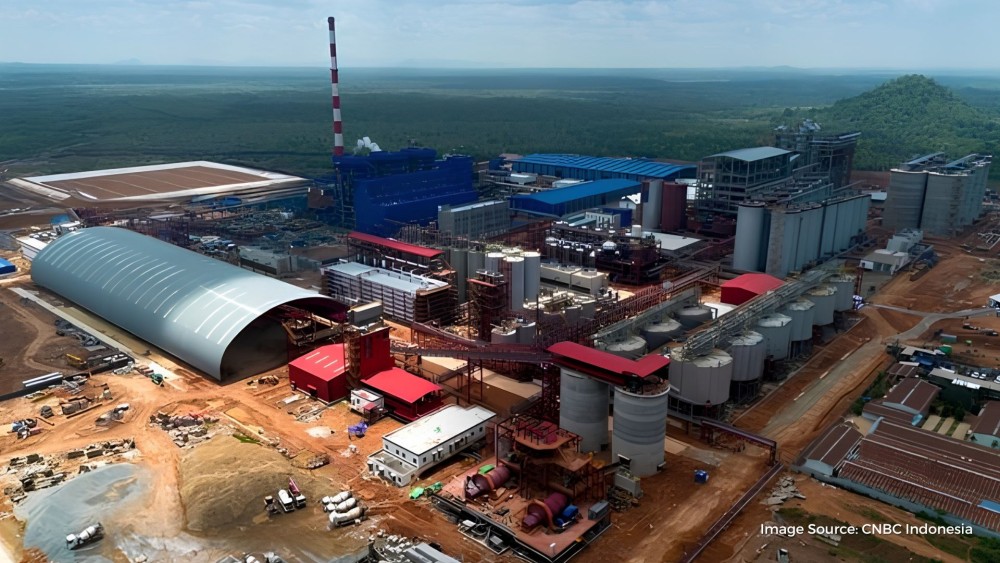
Indonesia’s sovereign wealth fund Danantara on Friday kicked off the first phase of its downstream industrial push, breaking ground on six projects with a combined investment value of about USD 7 billion (IDR 118 trillion), as the government accelerates efforts to strengthen value-added industries.
The ceremonial groundbreaking was led virtually by Danantara Chief Executive Officer Rosan Roeslani and senior executives and conducted simultaneously across five locations. The projects form Phase I of Danantara’s downstream program, a central pillar of President Prabowo Subianto’s economic agenda.
“With the six downstream projects launched today, the total investment reaches around USD 7 billion,” Rosan said at Danantara’s headquarters in Jakarta.
Two of the projects are located in Mempawah, West Kalimantan, and focus on strengthening Indonesia’s aluminum value chain. These include an integrated bauxite–alumina–aluminum processing and refining facility, as well as the second phase of the Smelter Grade Alumina Refinery (SGAR 2).
The third project is a bioethanol plant in Glenmore, Banyuwangi, East Java, jointly developed by state energy firm Pertamina and plantation company Perkebunan Nusantara (PTPN). The facility is expected to support Indonesia’s biofuel ambitions and reduce reliance on imported fossil fuels. Indonesia plans to produce 15.6 billion liters of biodiesel this year, a move expected to cut fossil diesel imports by IDR 139 trillion.
Indonesia currently enforces the B40 policy, which mandates a 40% palm oil blend in biodiesel. Energy Minister Bahlil Lahadalia has said the government may raise the mandatory blend to 50% in the second half of this year pending successful trials.
Danantara also broke ground on a biorefinery project in Cilacap, Central Java, which will convert used cooking oil into green fuels, including sustainable aviation fuel (SAF), or bioavtur. The project aligns with Indonesia’s push to expand renewable energy and reduce carbon emissions in the transport sector.
President Prabowo has said he wants Indonesia to become a leading global supplier of aviation fuel, as Jakarta tightens controls on exports of used cooking oil and palm oil residues. Last August, state-owned energy firm Pertamina said its aviation unit Pelita Air had used SAF made from used cooking oil on a commercial Jakarta–Bali flight for the first time.
The fifth initiative is an integrated poultry facility in Malang, East Java, aimed at strengthening national food security. Similar facilities are planned in Lampung, East Nusa Tenggara, and Gorontalo, although the Malang site was chosen as the ceremonial location for the groundbreaking.
The sixth project involves the construction of an industrial salt plant using Mechanical Vapor Recompression (MVR) technology in Gresik, East Java. The facility is intended to boost domestic salt production and reduce Indonesia’s reliance on imports of industrial-grade salt. Indonesia imported 2.61 million tons of salt in 2020, with volumes remaining above 2.7 million tons annually through 2024. The government aims to stop salt imports entirely by the end of 2027, following a directive from President Prabowo.
Rosan said the government expects the projects to generate a multiplier effect for the economy, including job creation and stronger industrial linkages. “The President has stressed the need to accelerate downstream projects that have a direct impact on the economy and on society,” he said.
Rosan, who is also the country's investment minister, added that downstream projects accounted for around 30% of total investment realized in Indonesia in 2025. He said the contribution, valued at about IDR 584.1 trillion, marked a 43.3% increase from the previous year.
Danantara plans to continue rolling out downstream initiatives. An upstream steel plant with annual capacity of 3 million tons is scheduled to break ground next month as part of efforts to boost domestic output and reduce reliance on imported steel.
The six projects launched on Friday form part of a broader pipeline of 18 downstream initiatives, which are estimated to require total investment of USD 38.63 billion, or about IDR 618 trillion.
Earlier reports had suggested the government would also break ground on coal downstreaming projects to convert coal into dimethyl ether (DME) on Friday, as Indonesia seeks to strengthen energy security and reduce reliance on imported liquefied petroleum gas (LPG). However, they were not part of Friday’s groundbreaking agenda.
Source: Jakarta Globe
Indonesia Identifies Eight Blocks with Large Rare Earth Reserve Potential
Indonesia has identified eight mining blocks with large potential for rare earth elements and plans to launch two research projects to develop rare earth processing technology, the head of a government mineral industry agency said on Monday.
Indonesia, an archipelago and the largest economy of Southeast Asia, has large reserves of a number of critical minerals as well as deposits of rare earth elements. Rare earths are a group of 17 elements including 15 silvery-white metals used to make magnets - which in turn power motion for electric vehicles, cell phones and missile systems.
The archipelago is also the world's largest producer of nickel products as well as the biggest exporter of tin.
Mineral Industry Agency Chair Brian Yuliarto said that the eight mining blocks with significant potential for rare earth elements and other strategic minerals were identified in places such as Kalimantan, Sulawesi and Bangka Belitung islands.
"Apart from rare earths, some of these blocks also contain several other minerals, namely tungsten, tantalum and antimony, which play a very large role in the defence industry," Yuliarto told members of parliament.
The blocks will be mined by the new state-owned miner Perminas, he added.
Yuliarto declined to give details on the estimated reserves for the minerals but said they had "promising enough" reserves to compete with other countries.
He said his agency planned to launch the two research projects "in the near future" in Mamuju, West Sulawesi in the centre of Indonesia, adding that the research projects will be done in parallel with preparations for mining exploration of the rare earth elements.
Source: Reuters

RELATED ARTICLES