This Week's Headlines (Mar. 14 - 20, 2026)
20 Mar 2026
RI, Japan Ink Strategic Pacts on Critical Minerals, Nuclear Power
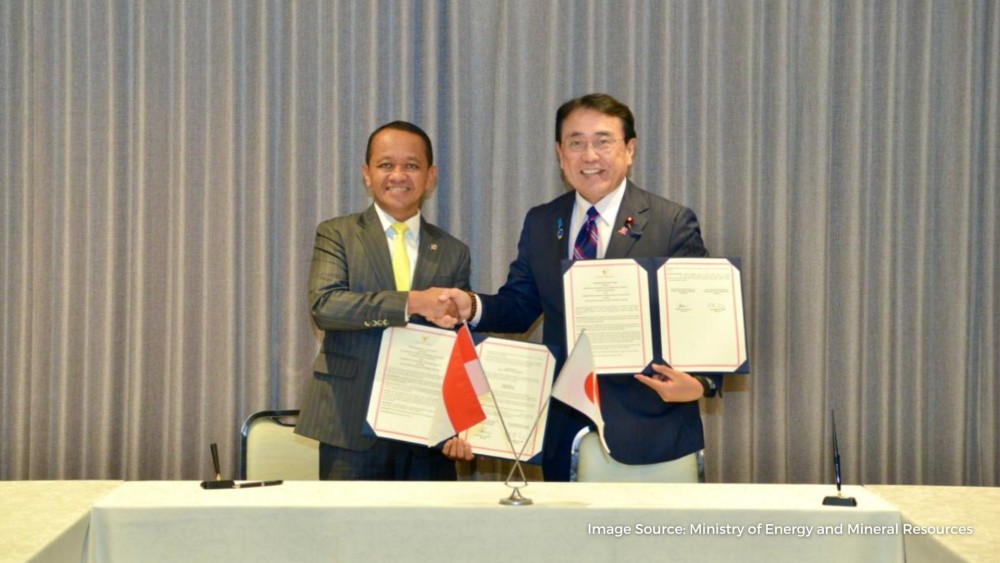
The government has inked a memorandum of cooperation with Japan to strengthen their partnership in the critical minerals supply chain and to develop nuclear energy technologies.
The agreement was signed on Sunday by Energy and Mineral Resources Minister Bahlil Lahadalia and Japanese Minister of Economy, Trade and Industry (METI) Ryosei Akazawa. The bilateral meeting took place on the sidelines of the Indo-Pacific Energy Security Ministerial and Business Forum (IPEM) in Tokyo.
In the critical minerals sector, the agreement is expected to strengthen global supply chains for greater security and reliability, while supporting the development of clean energy technology using Indonesia's strategic mineral resources.
Minister Bahlil welcomed the partnership, highlighting the potential for joint management of Indonesia's vast mineral wealth.
"We are very open and happy to ask the Japanese government and our Japanese business friends to manage our critical minerals in Indonesia," Bahlil said, in a statement issued on Sunday.
Minister Akazawa stressed the urgency of international cooperation in the current volatile climate, noting that Japan maintains strategic energy reserves as a precautionary measure against supply disruptions.
"Amid the current global crisis, we must strengthen cooperation to maintain energy security,” he said in the same statement.
The Japanese minister expressed appreciation for Indonesia's support regarding liquefied natural gas (LNG) exports, stressing Tokyo's commitment to completing joint projects, including the Legok Nangka waste-to-energy power plant as part of the two countries' strategic partnership.
Looking ahead, both nations also plan to deepen discussions on regional energy security, covering LNG and coal supply chains.
They also aim to accelerate projects under the Asia Zero Emission Community (AZEC) framework, including optimizing the Sarulla geothermal power plant.
These commitments are underpinned by Indonesia's vast resource potential, which Bahlil highlighted as a key driver for long-term collaboration.
"We know that Indonesia has 43% of the world's total nickel reserves, and we are also one of the largest players in bauxite, tin and copper. We have rare earth metals," he noted.
Source: The Jakarta Post
Indonesia’s Fishery Exports Reach IDR 16.7 Trillion as of March 2026
The Ministry of Marine Affairs and Fisheries (KKP) reported that the value of Indonesia’s fishery product exports from the beginning of the year until the period leading up to Eid, or mid-March 2026, reached USD 983.1 million (approximately IDR 16.7 trillion).
Head of the KKP’s Agency for Quality Control and Supervision of Marine and Fishery Products, Ishartini, as quoted from an official statement in Jakarta on Wednesday, explained that as of the temporary suspension of goods transportation on March 13, export volume of fishery products to various countries reached 197,718 tons.
The figure was calculated based on the issuance of Fishery Product Quality and Safety Certificates (SMKHP), which serve as a food safety standard requirement in 140 partner countries.
“The top ten leading commodities are vannamei shrimp, tuna, squid, blue swimming crab, seaweed, skipjack tuna, crab, tiger shrimp, ribbonfish, and octopus,” she said.
Ishartini noted that the countries with the highest absorption of Indonesia’s fishery products include the United States, China, Japan, Vietnam, Thailand, Malaysia, Australia, Saudi Arabia, and Singapore.
She acknowledged that geopolitical escalation in the Middle East has affected fishery export activities.
According to her, compared to the same period last year, export volume declined by 41.35%, while export value decreased by 21.71%.
Ishartini stated that demand for Indonesian fishery products remains relatively stable, as reflected in the continued processing of applications for Fishery Product Quality and Safety Certificates (SMKHP).
However, she acknowledged that export volumes have faced constraints due to supply chain disruptions caused by geopolitical escalation.
“In terms of volume, there are constraints due to supply chain disruptions impacted by the escalation, such as changes in shipment routes, additional logistics costs, and limitations in containers and mother vessels, all of which contribute to higher product prices,” she said.
To maintain trade stability, Ishartini stated that efforts will be made to increase domestic absorption of fishery products.
In addition, she noted that intensive communication is being carried out with authorities in partner countries as well as domestic stakeholders to anticipate the impact of the global situation.
Source: ANTARA
Indonesians in South Korea Can Pay with QRIS Starting April
The central bank recently announced that Indonesians would be able to use the national QR-based payment system QRIS when shopping in South Korea starting next month.
QRIS — which stands for the Quick Response Code Indonesia Standard — allows people to make payments simply by scanning QR codes using their smartphone camera. This payment method has skyrocketed in popularity as even Indonesia’s street vendors now embrace the technology. Bank Indonesia has also signed a series of agreements with its foreign counterparts to make QRIS available overseas, including South Korea. The system is set to go live in a few weeks time.
“We will launch the cross-border QRIS payment between Indonesia and South Korea in April 2026,” Bank Indonesia governor Perry Warjiyo told a briefing earlier this week.
The launch followed a memorandum of understanding signed between Bank Indonesia and the Bank of Korea back in 2024. Such linkage is expected to provide a boon for tourism as travelers will no longer have to exchange currencies. As Indonesia morphs into a major fanbase for Korean pop culture, the number of people from Southeast Asia’s biggest economy visiting Seoul is also on a rapid rise. Many are even running casual courier services or jasa titip (jastip) to get K-pop merchandise and skincare products.
In 2025, 365,596 Indonesians visited South Korea, marking a record high, according to the Korea Tourism Organization.
The QRIS launch is only adding to Korea's list of magnets for Indonesian tourists. South Korea not long ago announced it would grant Indonesia visa-free entry on a trial basis for groups of three or more tourists.
At home, QRIS is also on a triple-digit increase. Bank Indonesia reported that QRIS-based payment transactions had jumped 133.2% year-on-year in February.
Source: Jakarta Globe

RELATED ARTICLES



COMPANIES IN THIS SECTOR